On the flight back to the Northeast from Detroit, I found myself returning to a line from Socratic irony: “The more you know, the more you realize you don’t know.” After spending my first meaningful time in Michigan — not a layover, but a full immersion in the work of the Sugar Law Center (SLC) for Economic and Social Justice — those words feel less like a platitude and more like a precise description of where I am as a student and an aspiring lawyer.
The SLC was founded by Maurice Sugar (1891–1974), a labor lawyer of extraordinary conviction whose career spanned the early organizing drives of the United Auto Workers, the founding of the National Lawyers Guild, and a lifelong commitment to representing those without power against those with it. Working within an organization with that lineage made the experience feel weighted with history — and with obligation.
Much of my first year of law school has, by necessity, been theoretical. We read cases. We analyze them. We debate their implications for current law. But this experience reminded me that there is a category of understanding that can only come from applied legal work — from sitting with actual legal problems, actual clients, and actual stakes.
From the outset, I was engaged in discussions that brought our Civil Procedure coursework to life in ways the classroom cannot fully replicate. We examined the interplay between Rules 26, 34, and 45 of the Federal Rules of Civil Procedure — specifically, how and when a party can seek documents from non-parties through subpoena, what limitations govern such requests, and how practitioners navigate those constraints when more direct channels are unavailable or insufficient. The procedural mechanics we study as abstract doctrine take on an entirely different character when they are tools in an actual legal strategy.
The experience also deepened my engagement with Fourteenth Amendment due process — a subject I had been exploring in the classroom but which took on new complexity in practice. The foundational question of what constitutes a constitutionally protected property or liberty interest, as articulated in Board of Regents v. Roth, 408 U.S. 564 (1972), is deceptively simple to state and remarkably difficult to apply. The Mathews v. Eldridge balancing test — weighing the private interest, the risk of erroneous deprivation, and the government’s interest — is elegant in the abstract but demanding in practice, where facts rarely align neatly with doctrinal categories.
I also continued to grapple with First Amendment associational rights — in particular, the doctrine of intimate association as developed in Roberts v. United States Jaycees, 468 U.S. 609 (1984). The deeper question that emerged for me was how courts assess whether adverse action has been taken against an individual based on protected associational ties — whether familial, civic, or political in nature — and what evidentiary and doctrinal frameworks govern that inquiry. These are not purely academic questions; they arise in real employment and civil rights contexts, and the answers carry real consequences for real people.
Even our torts coursework intersected with the work. Discussions of products liability raised questions about proper venue, the relevant facts that can determine jurisdiction, and the standards of manufacturer liability that trace back to Greenman v. Yuba Power Products, 59 Cal.2d 57 (1963), and the Restatement (Second) of Torts § 402A — foundational doctrine that still governs how courts assess defective products today.
Even before arriving at the SLC, the engagement surfaced questions about written contracts — specifically, the limits of comprehensive drafting. Can a contract truly anticipate every contingency? At what point does specificity become a liability rather than a safeguard? These are questions that seem abstract in a Contracts course but become urgent the moment you are working within an agreement that governs what you can and cannot do.
I kept returning to a phrase from Professor Varyani’s Property course: “words matter and relationships are everything.” That ethos traveled with me to Detroit. Whether in the context of due process doctrine, contract interpretation, or the relationship between a lawyer and a client, precision of language and quality of relationship are not soft values — they are professional imperatives.
Perhaps the most challenging dimension of the experience was confronting the ethical and emotional complexity of legal representation in the public interest context. What does it mean to work on behalf of someone whose situation may be sympathetic but whose legal prospects are limited? What obligations arise when you connect with a client — or their cause — in ways that go beyond the professional relationship? What do you do when you believe someone is partly responsible for the situation they are in, yet can see clearly that walking away leaves them worse off? These are not questions with clean doctrinal answers. They are questions that lawyers navigate through judgment, professional ethics rules, and the harder-to-teach quality of wisdom.
Detroit itself was a revelation — and a provocation. I have spent time in places undergoing dramatic transformation: watching Shanghai expand its subway system from three lines to thirteen in under a decade left an impression of what sustained investment and political will can produce. Detroit presents a different kind of complexity. Entire city blocks defined by blight. Magnificent historic brick buildings vacant and slated for demolition. A public transit system that all but disappears on weekends. And yet: one of the finest urban riverwalk systems in the country. A downtown that is genuinely alive. Investors like Dan Gilbert of Rocket Mortgage placing major bets on the city’s future, reportedly owning enough downtown property that a lighted map of his holdings illuminates a remarkable portion of the city center.
Warren Buffett famously observed that the time to invest is often when others are retreating — that adversity reveals character and capacity in ways that prosperity cannot. There is something in that observation that translates, imperfectly but meaningfully, to public interest law. The communities and clients that most need skilled legal representation are often those in precisely the circumstances that commercial legal markets bypass. Investing legal talent where it is scarcest is not merely charitable — it is, in the long run, essential to the integrity of the system.
The Chinese expression 矛盾 (máodùn) — literally “spear and shield,” the word for contradiction or paradox — captures something of the experience. It is bittersweet. Detroit is a city of real contradictions: beauty alongside blight, investment alongside disinvestment, possibility alongside neglect. The law itself contains contradictions that lawyers spend careers navigating.
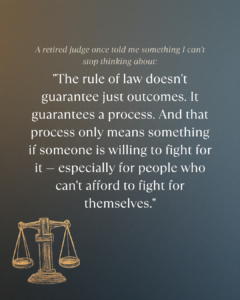
I keep returning to a conversation I once had with a retired Massachusetts judge who had spent his career on some of the most serious criminal matters the system produces. I asked him how he was able to represent clients he knew to be guilty — whether that did not create an ethical conflict. His answer was precise: the rule of law does not guarantee just outcomes in individual cases. It guarantees a process. The underlying architecture of our judicial system — the right to counsel, to confrontation, to due process — is more foundational than the outcome of any single case. The system’s integrity depends on everyone within it taking those procedural commitments seriously, even when, especially when, doing so is inconvenient.
That answer has not left me. I came back from Detroit with more questions than I arrived with. I think that is the point.
I am grateful to the team at RWUSOL and the Feinstein Center for making this possible — and to the Sugar Law Center for the generosity and rigor they brought to hosting interns.
